
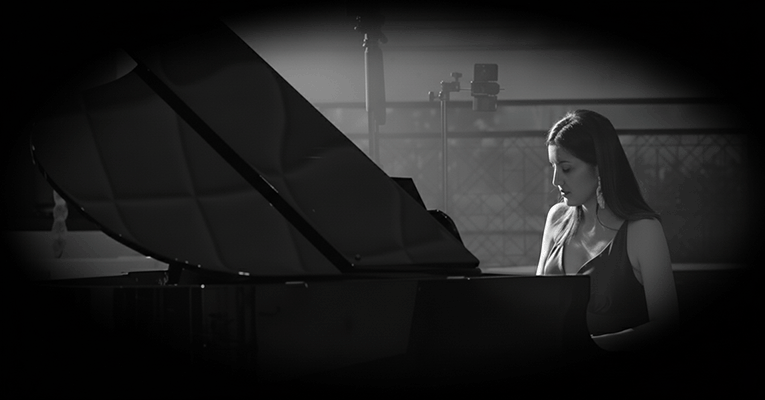
Sabina Khujaeva Abay (b. 1988) is a pianist and composer whose artistic voice bridges the traditions of Central Asia with contemporary compositional practices. Originally from Tashkent and now based in Istanbul, her music blends Uzbek and Turkish traditions with innovative approaches to timbre, rhythm, form, and spatial sound. Her works span acoustic, electroacoustic, orchestral music, and film scoring, often engaging in transcultural dialogues.
Equally devoted to the classical repertoire as a pianist, she released her debut solo album in 2021 and is currently preparing her next recording. Balancing a dual identity as performer and composer, she continues to explore the dialogue between interpretation and creation.
Sabina’s musical journey began at the V. Uspensky Special Music School for gifted children in Tashkent, where she studied with Gulnara Umarova and Irina Berlin. She later graduated with Bachelor’s and Master’s degrees from the State Conservatory of Uzbekistan under Prof. Dr. Felix Yanov-Yanovsky. During this period, she actively participated in the Omnibus Laboratory, attending masterclasses with Manfred Stahnke, Joel Bons, Seung-Ah Oh, Roland Moser, Tom Johnson, Peter Adriaansz, Ernestine Stoop, and Bang on a Can. In 2013, her work Thirteen Signs of the Zodiac won First Prize in the Competition for the Best Micro-chromatic Music, performed by the Omnibus Ensemble. Beyond chamber and experimental works, she has composed large-scale projects, including the Concerto for Guitar, Cello, Kanun, and Orchestra (2012) and the Concerto for Violin and String Orchestra (2007), premiered by Guzal Tadjikulova with the State Theatral Orchestra of Uzbekistan, conducted by Prof. Dr. Zahid Haknazarov.
In 2019, she completed her second Master’s degree at the Centre for Advanced Studies in Music (MIAM) at Istanbul Technical University under Associate Prof. Dr. Reuben de Latour. Her thesis, Spatialization Through Geometrical Sound Movements in Persephassa by Iannis Xenakis, reflects her deep engagement with spatial music. At MIAM, she participated in numerous masterclasses, workshops, and festivals, including with composers Tomas Simaku and Daniel Asia. She is currently pursuing her Ph.D. in Composition at MIAM under Assistant Prof. Dr. Manolis Ekmektsoglou, focusing on multidimensional music through acoustic instruments.
Sabina’s works have been performed internationally by leading ensembles such as Schallfeld Ensemble, Hezarfen Ensemble, and Omnibus Ensemble. Highlights include Ardent Meditation (2018), featured on MIAM’s electroacoustic album (2019); Wings (2018), a spatial piece for eight speakers presented at the Mixture Festival (Barcelona) and Sesin Yolculuğu Festival (Istanbul); Weepie (2019, 2021), performed by Hezarfen Ensemble at international conferences and concerts; and Astray (2021), composed for the 10th International Cappadocia Music Festival’s “Re-Imagining the Brandenburg Concertos” project and later performed at Saruhan Caravanserai (Cappadocia) and CRR Concert Hall (Istanbul). Recent works include Phobia to Phobia (2022) for Hezarfen Ensemble, Integration (2023) for clarinets and fixed media at the Symposium of Sonic Practices in Arter Museum, and Resist (2024) for Schallfeld Ensemble.
Her activity also extends into film scoring. In 2024, she released the original soundtrack album for the film Cadi, adapted from Hüseyin Rahmi Gürpınar’s novel and directed by Erman Bostan. Her most recent project is the soundtrack for Mehmet Öner’s documentary Never Again, scheduled to premiere soon.
As a pianist, Sabina has performed at venues including Yeldeğirmeni Sanat, the Austrian Cultural Office, and the Prof. Dr. Türkan Saylan Cultural Centre in Istanbul. She also serves on the board of directors of 7s KED (Cultural Educational Association of Seven Arts), supporting projects that provide scholarships and educational opportunities for young musicians and artists. She has also contributed to WeMusic, a project co-funded by the European Union.
Guided by a passion for the visual arts and cross-cultural creativity, Sabina’s work reflects openness to experimentation and dialogue between traditions and aesthetics. Through her music, she seeks to create immersive sound worlds where cultural heritage meets contemporary imagination.